
Fighting Wildfires with AI: Discover AstraCore AI at the HEIPowered Startup Pitch Competition
Meet AstraCore AI, one of the five finalists of the HEIPowered Startup Pitch Competition 2026! This Bulgarian startup is developing Astra.Wildfire, an AI-powered platform designed to predict and prevent wildfires.
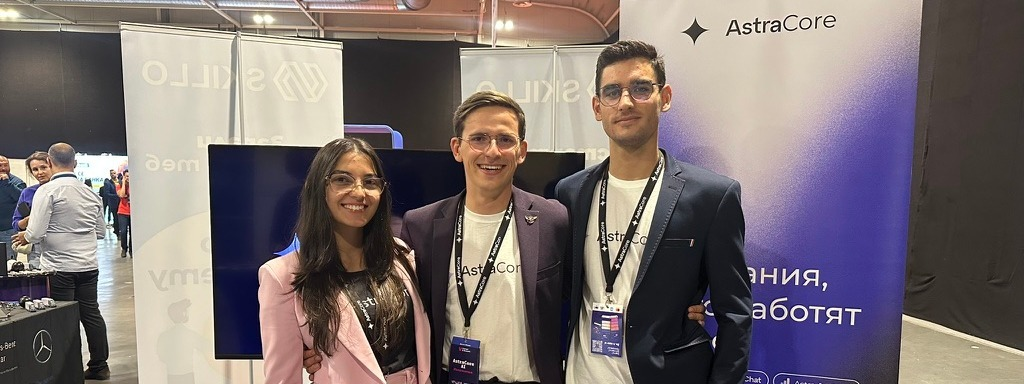
We interviewed Kostadin Taligadzhiev, Co-founder and Sales Director, who leads product and business development alongside Egor Semenov, Co-foudner and CTO, responsible for technical development, and Ema Dilova, Financial Director.
Discover their entrepreneurial journey, the challenges they've faced and their ambitions for the future!
Tell us about your startup. What does it do, and what problem are you trying to solve.
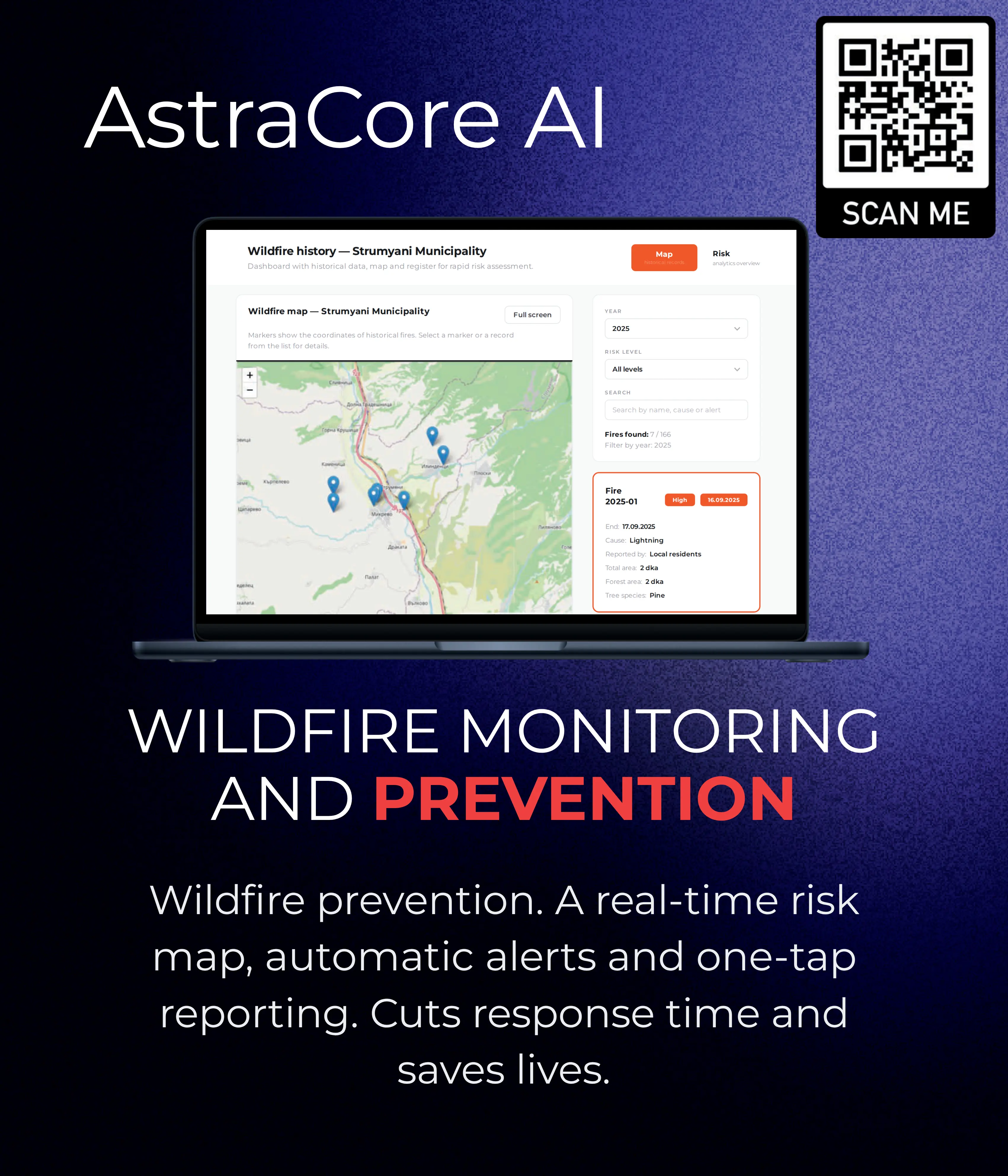
Astra.Wildfire is an AI-powered platform focused on predicting wildfire risk and supporting prevention and better decision-making before fires become disasters.
Wildfires are becoming an increasingly serious problem across the European Union. Around 60,000 wildfires occur in the EU each year, and the European Commission estimates their economic losses at approximately €2.7 billion annually. In 2023 alone, 504,002 hectares burned across the EU, with at least 41 wildfire-related deaths reported. In 2025, for the first time, the total area affected by wildfires in the EU exceeded one million hectares.
Behind those statistics are destroyed homes, forests, businesses and infrastructure, displaced communities, injured firefighters and lost lives.
Astra.Wildfire is our attempt to use AI, environmental data, Earth-observation data and scientific research to understand where wildfire risk is developing before a fire starts. Our goal is to provide authorities and other stakeholders with more precise, data-driven risk information so they can focus prevention efforts and resources where they are needed most.
How did the idea come about, and how did your entrepreneurial journey begin?
The idea came from something very simple.
During the wildfire season, wildfires became one of the most discussed topics among citizens and across national television. Every day we were hearing about another fire, another destroyed area, another evacuation or another life affected.
Everyone was talking about how destructive the problem was, but we rarely heard anyone discussing what more could be done to prevent these fires before they started.
That got us thinking: we have access to AI, software engineering, large amounts of data and academic expertise. Could we use these technologies not simply to observe wildfires after they happen, but to better predict where they are likely to happen in the first place?
That question became the beginning of Astra.Wildfire.

Which EIT Higher Education Initiative project supported you, and how did it help you develop your startup?
We were supported through Climate Engine – HEIs as Innovation Engines for Place-based Climate Solutions, an EIT Higher Education Initiative project focused on turning higher education institutions into drivers of practical climate innovation.
For us, its value went far beyond traditional startup support. Through the programme, we gained access to workshops, academic expertise, industry specialists and real historical datasets that could help us develop and validate the wildfire prediction model. One of the greatest advantages was being able to bring different disciplines together. Our AI experts and engineers could work alongside professors and specialists who understand forestry, wildfire behaviour and environmental science.
That combination has been extremely important because Astra.Wildfire is not just a software challenge. To build something genuinely useful, the technology has to be based on sound scientific understanding.
What has been the biggest challenge in your entrepreneurial journey so far?
The biggest challenge has been developing the mathematical risk model behind the platform, particularly incorporating the human factor.
Weather conditions such as temperature, wind, humidity and drought are important, but they are only part of the wildfire-risk equation. Human activity is also responsible for a significant proportion of wildfire ignitions, and modelling human behaviour is much more complex.
We therefore need to determine which variables should be included, how strongly each variable should influence the final risk score, and how those relationships change depending on location and conditions.
Professors and industry specialists are working closely with our AI experts and engineers to refine this model. At the same time, obtaining sufficiently detailed, reliable and compatible historical data for training and validating it remains a major challenge.
For us, accuracy is much more important than simply releasing something quickly.
Where is the startup today, and what have you achieved so far?
Today, we already have the first working version of the Astra.Wildfire platform, and it continues to develop every day.
The core concept and technical architecture are in place, but a large part of our current work is still focused on research, data and validation. We are refining the mathematical risk model, curating the datasets used by the system and working on connecting the different data sources into one unified platform.
This is an important stage for us because the quality of the final prediction ultimately depends on the quality of the underlying science and data.
We do not consider the research finished yet. The current platform is the foundation on which we are building the much more complete and accurate system that we want Astra.Wildfire to become.
What makes your approach or solution different?
Today, we already have the first working version of the Astra.Wildfire platform, and it continues to develop every day.
The core concept and technical architecture are in place, but a large part of our current work is still focused on research, data and validation. We are refining the mathematical risk model, curating the datasets used by the system and working on connecting the different data sources into one unified platform.
This is an important stage for us because the quality of the final prediction ultimately depends on the quality of the underlying science and data.
We do not consider the research finished yet. The current platform is the foundation on which we are building the much more complete and accurate system that we want Astra.Wildfire to become.
What does it mean to you to be part of the EIT Higher Education Initiative Community and to have opportunities such as the HEIPowered Startup Pitch Competition?
For us, this is an opportunity to do much more than present a startup.
It gives us a platform to raise awareness about a problem that affects communities across Europe and to meet people who may help us turn an ambitious research idea into something that can genuinely be used.
Our motivation behind Astra.Wildfire is very personal. We want fewer destroyed homes, fewer devastated forests and, most importantly, fewer casualties. We want that for ourselves, for our parents and eventually for our children.
The HEIPowered Startup Pitch Competition gives us the opportunity to put this problem in front of researchers, innovators, institutions and potential partners who may be able to help us move closer to that goal.
For an early-stage project addressing such a complex challenge, that exposure and access to a broader European innovation community can make a significant difference.

What does being one of the five finalists mean to you, and what would securing one of the three winning positions enable you to do?
Being selected as one of the five finalists is already meaningful to us because it shows that people outside our own team see potential in both the problem we have chosen to address and the approach we are taking.
Securing one of the three winning positions would allow us to accelerate the part of the project that matters most right now: the research.
We need access to additional and higher-quality datasets, further validation of the mathematical model and continued collaboration with researchers and domain experts. These resources would allow us to test the approach more rigorously and determine how accurately it can perform in real-world conditions.
Ultimately, we want to move from saying, “We believe this can work,” to demonstrating with real data that it works and can help people.
What are your next steps, goals or biggest needs as you look to grow the startup?
Our immediate priority is not rapid commercial expansion. It is completing the research and building the strongest possible foundation for the technology.
To achieve that, we need to secure several key partnerships.
We want to collaborate with technology companies that can provide access to infrastructure, Earth-observation capabilities and large-scale datasets. At the same time, we need deeper collaboration with universities, wildfire researchers, forestry specialists, public authorities and professionals who understand the problem from the field.
AstraCore is already collaborating with the University of Forestry in Sofia on the wildfire prediction and prevention project, and we want to expand this multidisciplinary network further.
Wildfires are far too complex to solve from a software-engineering perspective alone. Our next stage is about bringing the right technology, data, science and practical expertise together.

What advice would you give to other founders at the beginning or early stages of their entrepreneurial journey?
Do not quit simply because what you are building turns out to be harder than you expected.
We all know the famous stories about technology companies that started with a few people in a garage and eventually changed entire industries. What we hear much less about are all the potentially great ideas that were abandoned before they ever had the opportunity to prove themselves.
Entrepreneurship rarely follows the plan you originally imagined. You will make mistakes, change direction, discover that some of your assumptions were completely wrong and face problems that you did not even know existed when you started. But every one of those experiences is valuable.
Keep learning, keep adapting and keep pushing forward. Give your idea the opportunity to become one of the success stories that future founders hear about.
Why do you think it is important for higher education institutions to support entrepreneurship and startups through initiatives like the EIT Higher Education Initiative?
One of the most important things an early-stage entrepreneur can receive is evidence that their idea is worth exploring.
At the beginning, you normally have far more questions than answers. Having a respected university, professor, researcher or programme take your idea seriously provides motivation, but it also provides something even more important: expertise. Initiatives such as the EIT Higher Education Initiative connect entrepreneurs with knowledge and specialists that would otherwise be extremely difficult for an early-stage startup to access.
In our case, that connection is fundamental. We can build AI and software, but that alone does not make us experts in forestry, wildfire behaviour, environmental science or climate modelling. Collaboration with higher education institutions gives us access to those disciplines.
That interaction between entrepreneurs, researchers and industry is where ideas can become scientifically grounded, practical solutions rather than remaining only ideas.

Is there anything else about your startup, team or journey that you think people should know?
One thing that is important to us is that Astra.Wildfire is genuinely multidisciplinary.
Our engineers and AI specialists cannot build this solution alone. We work with professors, researchers and industry specialists, including through our collaboration with the University of Forestry in Sofia, because every part of the system has to connect technology with real scientific and practical knowledge.
We are also very conscious that we are still at the beginning of this journey. We are not claiming that we have solved the wildfire problem. We have a working platform, a developing model and a clear direction, but there is still substantial research, validation and engineering ahead of us.
What we do have is a team determined to continue that work.
Our ambition is for Astra.Wildfire to become a tool that helps authorities move from reacting to wildfires towards understanding risk earlier, improving prevention and making better-informed decisions before lives, ecosystems and infrastructure are already in danger.
Meet Kostadin Taligadzhiev in our Community.